How to Tell If an Oil Change Coupon Is Real (November 2026)
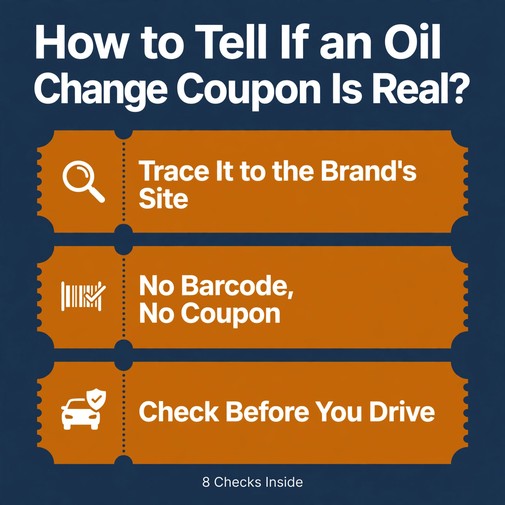
A coupon is real only if you can trace it to the brand’s own site. Open the brand’s coupons page and find the same offer there. A real offer ends in a barcode, a store page you can open, a printed coupon, or a live text or email on your phone. If it exists only on a coupon-listing site, it is a lead, not a coupon, no matter how confident the page looks.
Coupon checks verified November 8, 2026.
What Makes an Oil Change Coupon Real?
One thing: you can trace it to the brand’s own site. Open the brand’s coupons page and find the same offer there. If it exists only on a coupon-listing site, it is a lead, not a coupon, no matter how confident the page looks. A real offer ends in a barcode, a store page you can open, a printed coupon, or a live text or email on your phone.
| Brand | How a real coupon arrives | What to show |
|---|---|---|
| Jiffy Lube’s coupon pages | Find coupons by ZIP on jiffylube.com; the code, the offer, and the expiry print on the page. | Show the code at the counter. |
| Valvoline’s coupon pages | Store coupons by text, email, or print from the store page; campaign coupons as a barcode on the campaign page. | Show the barcode on your phone, or print the page. |
| Take 5’s official coupons | Sign up on the official coupons page; the live coupon arrives by text or email. | Show the live coupon on your phone. Screenshots are not accepted. |
| Firestone’s offers page | Print, email, text, or screenshot from the official offers page. | Print it, or take a screenshot. Firestone is the one brand where screenshots work. |
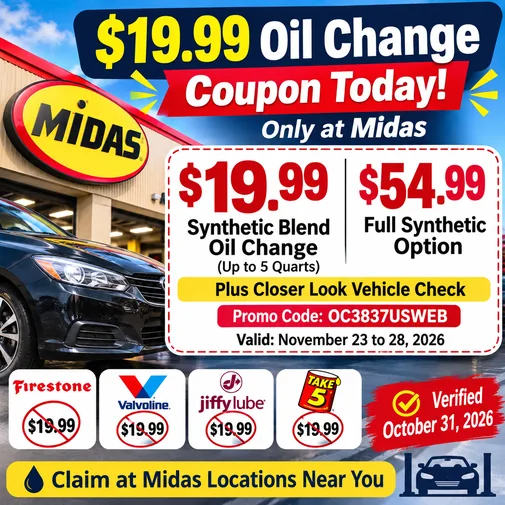
| Midas’s coupon pages | Store-unique coupons on individual store pages. | Present your store’s own coupon at time of service. |
| Express’s coupon page | National codes on expressoil.com; present at time of service. | Present the coupon at the counter. |
That is the master check. Everything else in this post is a faster way to fail a coupon that already fails it.
When Is a Coupon Too Good to Be True?
When it promises a price the brand has never charged.
A $24.99 fixed-price Valvoline coupon is the textbook case. An October 2026 investigation found no coupon at all: no barcode, no code, no PDF, nothing to print, nothing to show on a phone. One page listed the expiry as September 31, 2025, a date that does not exist. Another was recycled text from 2024 sitting under a 2026 title. A full synthetic change typically runs $80 to $110 or more before any coupon, according to the same investigation, and even the genuine Valvoline’s $25 off coupon brings it to about $55 to $85. A $24.99 total was never a price. It was a search term with a page built around it.
The second tell is the discount itself. Valvoline’s real offers are flat dollars: $20 off for new customers at participating stores, $15 off full synthetic or blend, $10 off conventional. A percentage-off Valvoline code contradicts the brand’s own system. The same logic catches a storewide 50% Jiffy Lube code: the real 50% offer is Oregon and southwest Washington conventional oil only, code JHUC82, not a nationwide discount.
One exception keeps the rule honest. Valvoline’s $30 campaign did print typed codes on vioc.com itself, NANABT4 and NANABU4, and that campaign ended November 8, 2026, at 8:00 PM Eastern. The rule is narrower and stronger than “Valvoline never has codes”: a typed Valvoline code is real only if it appears on vioc.com itself. Any typed code found only on a third-party site fails.
What Are the Signs of a Fake Coupon?
Five signs, and any one of them is enough to stop.
- An impossible date. September 31 and November 31 do not exist. A page that lists one as an expiry date was built from a template, not from a real offer.
- A checkout flow that does not exist. Pages that tell you to paste a code at checkout on the Take 5 or Jiffy Lube website are inventing a flow: neither brand sells oil changes through a web checkout.
- A price the brand never charged. A $24.99 total for a full synthetic oil change is a headline, not a coupon.
- A code that lives only on listing sites. The real Jiffy Lube military code is MILITARY25, group-level, not national. A different military code that appears nowhere on jiffylube.com is not a second real code.
- A title date that does not match the offer. Recycled text from 2024 sitting under a 2026 title is a freshness fake: the date on the page is not the date of the offer.
One more caution: a barcode alone proves nothing. Counterfeit coupons can carry fake or manipulated barcodes too. The barcode is one clue, not the answer.
A real coupon’s terms are worth reading too. The decoder explains what ‘not valid with other offers’ blocks, so you know which discount you are giving up.
Should You Call the Store Before You Drive?
Yes, if any check above leaves you unsure. It is the final check, not the first resort.
Call the shop and ask three things: whether the coupon is valid at that store, what it covers, and which oil type and filter it includes. The call costs less than a wasted trip, and the store’s answer is the only confirmation that counts at the counter. Find the store first, then call: find your Jiffy Lube store shows the participating locations near you.
Are Coupon-Listing Sites Ever Right?
Sometimes they copy a real offer, but a copy is not a source. The offer is real only if the brand’s own site shows it too.
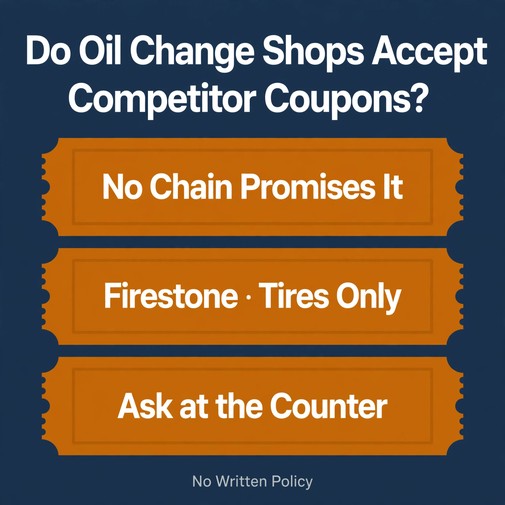
A listing site can be right by accident: it may have copied a real coupon from the brand’s page. That does not make the listing site the source. Check the offer on the brand’s own site, and treat the listing as a lead, not a coupon. The same rule answers the competitor question: whether a coupon works at another shop is a separate question from whether it is real, and whether a competitor’s coupon works at another shop has its own answer.
One more resource, used with care: the Coupon Information Corporation keeps a blacklist of counterfeit coupons, but it covers manufacturer product coupons, not oil-change service coupons, so it cannot verify a shop offer. The brand’s own site is the check for service coupons.
Frequently Asked Questions
Is there really a Take 5 promo code?
No. Take 5 has no promo codes and no online checkout, so there is nothing to type a code into. Its real offers arrive as a live coupon by text or email, shown on your phone. Any page showing a Take 5 code to copy is describing a flow that does not exist. See Take 5’s live coupons for how the real ones arrive.
Why do Valvoline coupons never show a percentage off?
Because Valvoline’s system is flat dollars: $20 off for new customers, $15 off full synthetic or blend, $10 off conventional. One October 2026 review that checked 99 stores found exactly zero percentage-off Valvoline coupons. A percentage-off Valvoline code fails by system. The current offers are on Valvoline’s flat-dollar offers.
What if a coupon has an impossible expiry date?
Stop. September 31 and November 31 do not exist on any calendar. A page that lists one as an expiry date was built from a template, not from a real offer. The $24.99 Valvoline pages are the textbook case: one listed September 31, 2025, a date that does not exist.
Can a barcode prove a coupon is real?
No, not by itself. A real offer usually ends in a barcode, a store page, or a live text, but counterfeit coupons can carry fake or manipulated barcodes too. The barcode is one clue. The check that matters is whether the same offer appears on the brand’s own site.
I found a coupon, but I am still unsure. What now?
Call the store before you drive. Ask whether the coupon is valid there, what it covers, and which oil type and filter it includes. That call is the final check, not the first resort, and it costs less than a wasted trip.
A real coupon leaves a trail. It lives on the brand’s own site, it ends in something you can show, and it matches the way that brand sells. If you cannot find the trail, do not drive to the store on a stranger’s word. The coupon that saves you money is the one you verified before you left home.
Our bottom line: we hold our own pages to this test. If a coupon does not live on the brand’s official site, it does not get listed here as real — the trail has to exist before we send you to a store with it.