Valvoline vs Express Oil Change: The Paper Champion Against the Everywhere Chain (November 2026)
Read only what the two companies publish, and this comparison looks upside down. Express Oil Change, a regional chain with 445 locations in 19 states, promises a faster visit, a longer free check, printed starting prices and a published warranty. Valvoline Instant Oil Change, with more than 2,100 locations nationwide, publishes none of those four things in the same way.
The twist sits under the hood, because Express pours Valvoline oil, the same brand its rival sells from its own bays. What separates the two chains is not the product in the jug but everything wrapped around it: the clock, the checklist, the price page and the paper trail. This comparison scores the promises first, then asks whether a store exists near you.
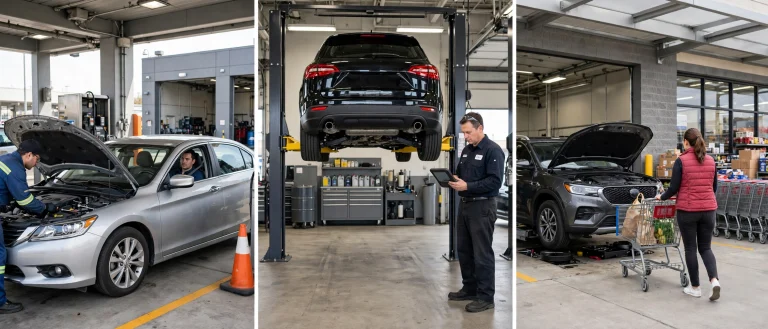
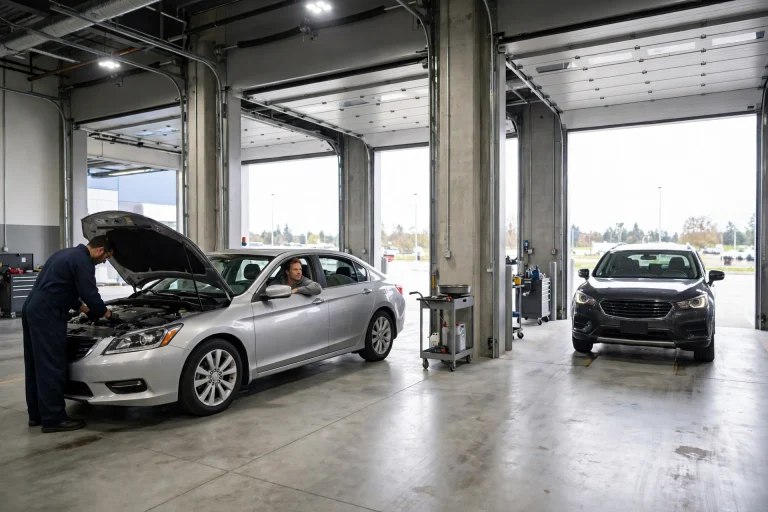
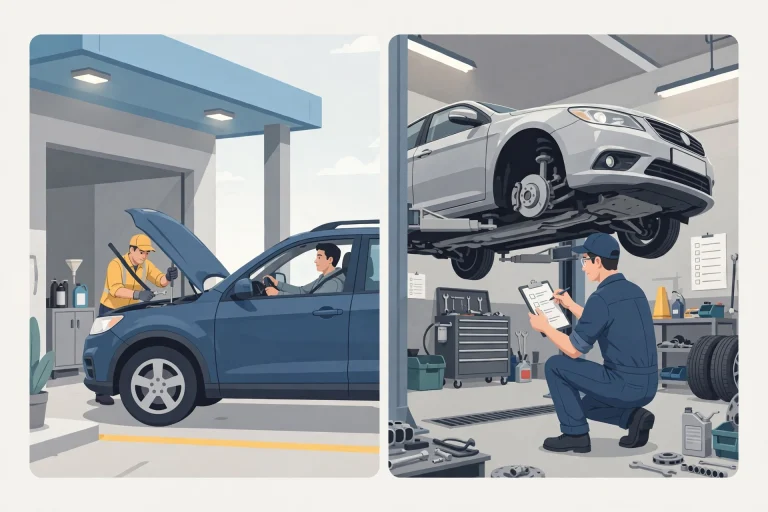
Both visits work the same way at the door. You drive in without an appointment, stay in your seat while technicians work from above and below, and keep your keys the whole time. From that shared starting point, the two chains make very different promises, and the table below lays them out side by side.
| Valvoline Instant Oil Change | Express Oil Change & Tire Engineers | |
|---|---|---|
| Published time | About 15 minutes, oil change and check | 10 minutes, oil change and inspection |
| The visit | Stay in your car, no appointment taken | Stay in your car, no appointment needed |
| Free check included | 18-point maintenance check | 20-point inspection |
| Oil poured | Valvoline, up to 5 quarts | Valvoline, to the manufacturer’s specification |
| Starting prices published | No | Yes, for three of four oil types |
| Warranty on the oil change | None published on its website | 3 months or 3,000 miles, published |
| JD Power 2026 quick oil change score | 823, tied third | 854, first, fourth straight year |
| Locations | More than 2,100 nationwide | 445 across 19 states |
The Paper Champion Audit
Start with the scorecard, because on paper it is not close. Express promises the oil change and its inspection in 10 minutes, against about 15 at Valvoline for the same bundle. Express counts 20 inspection points against Valvoline’s 18, prints starting prices on its own service page, and publishes a warranty for the oil change itself. Valvoline’s pages do none of those four.
The satisfaction title sits on the same side of the ledger. In JD Power’s 2026 Aftermarket Service Index, Express scored 854 in the quick oil change segment, first for the fourth straight year. Valvoline scored 823 in the same segment, tied for third. These two chains are measured in one league table, and the regional chain is the one wearing the crown.
Even the fine print leans the same way. Express’s warranty, three months or 3,000 miles on parts and labor, is written on a public page any driver can read before the visit. Valvoline publishes no service warranty on its website at all, so its promise exists only on whatever the receipt says after the work is done. On published evidence alone, the smaller chain wins the audit.
One row of the scorecard, though, is not a promise, and it reverses the result for most readers. Express runs 445 locations across 19 states, concentrated in the Southeast where it began in Birmingham, Alabama, in 1979. Valvoline runs more than 2,100 locations nationwide. The drivers who can use the paper champion are a minority of the drivers reading about it, and that imbalance shapes everything below.
Ten Minutes Against Fifteen
The clocks are the fairest fight in this comparison, because both numbers cover the same bundle. Express says its 10 minutes includes the full oil change and the complimentary 20-point inspection, start to finish. Valvoline says its oil change and 18-point maintenance check together take about 15 minutes. Neither chain is timing the oil alone while quietly excluding the check.
The edges are where the claims soften. At Express, anything the inspection finds, a dirty air filter or worn wiper blades, needs your approval first, and approved extras add a few minutes to the visit. Valvoline takes no appointments at all and serves drivers first come, first served, so its 15 minutes begin only once your car is over the pit.
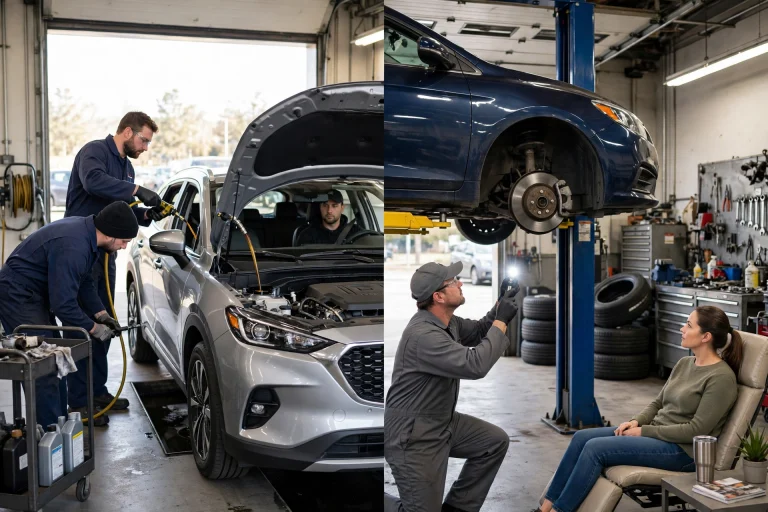
The visit itself feels identical at both chains. You stay in your seat, the crew works from above and below at once, and at Express the company puts it plainly: there is no waiting room because there is no waiting. Five minutes of published difference is real, but it is the smallest gap on the scorecard.
Twenty Points Against Eighteen, and the Tread-Depth Line
Express knows exactly whose number it is beating. Its inspection page announces 20 points and adds that leading competitors check 18, a figure that belongs to Valvoline. The two lists overlap heavily: fluids, belts and hoses, both air filters, battery, lights, wipers, tire pressure and chassis lubrication appear on each. The contest is over the handful of items only one side counts.
Express’s extra points are specific. Its list counts the horn, the clutch fluid and the oil reminder light reset as a named completion step, and it offers the front and rear differentials and the transfer case on request. Valvoline’s list answers with two visual inspections Express does not name, one under the hood and one under the chassis, and a battery test limited to participating locations.
Then there is the line neither list honestly crosses. Express’s itemized list promises a visual inspection of tire wear, yet its own FAQ says the inspection checks tire tread depth, and the two wordings are not the same promise. Valvoline is blunter: a footnote on its check states plainly that it does not measure or capture anything about tread depth. On the published lists, neither chain measures your tread.
That matters because tires are Express’s second trade; the company name ends in Tire Engineers. A driver expecting the 20-point inspection to grade the tires the way a tire shop would is reading more into the list than the list contains. What both checks genuinely deliver is an early warning on fluids, filters and wear items, delivered before you leave.
The Same Oil in Both Bays
The strangest row on the scorecard is the oil itself. Express’s oil change page carries Valvoline branding across its oil imagery, with containers labelled for conventional, synthetic blend, full synthetic and high mileage oil. The page’s prose names no brand and says only that the oil meets the manufacturer’s specification, but the product in the pictures is the rival’s own.
Valvoline’s shops pour the same brand from the company’s named lines, with up to five quarts and a Valvoline filter included in the standard service. So the driver choosing between these chains is not choosing between two oils. The jug is settled before the visit starts, and every real difference lives in the service wrapped around it.
That sameness quietly removes the most common reason drivers pick a branded oil change shop. Brand loyalty to an oil still works at Valvoline, where the oil and the shop share a name. At Express it works in reverse: the shop sells someone else’s oil and competes on speed, checks and paper instead.
The Price One Side Prints
Before the visit, one chain tells you roughly what the oil change starts at and the other does not. Express prints starting figures for three of its four oil types, conventional, high mileage and full synthetic, on the oil change page itself. A driver can read them at home, compare them with the car’s needs, and arrive knowing the shape of the bill.
Valvoline prints no base price anywhere on its national site. Its pricing page lists the factors that move a price, the oil type, the number of quarts and any discounts, then sends drivers to the local store or an online chat for a quote. What Valvoline drivers actually report paying is tracked on this site’s Valvoline prices page, built from the figures the chain itself will not publish.
Express hedges its own transparency, which keeps the contrast honest. The same page that prints the starting figures carries an FAQ telling drivers to ask the technician for the price on arrival. Printed starts are still more than Valvoline offers, but neither chain will hand you a final number before the car is in the bay.
The Decision, by Where You Live and What the Car Needs
If an Express sits within your normal driving radius, the paper champion is simply the stronger offer. You get the faster promise, the longer check, a printed starting price and a written warranty. For Southeast drivers the comparison is not close, and the table at the top is the whole argument. Its current offers sit on this site’s Express coupons page for drivers who want the saving priced in too.
Everywhere else, the decision makes itself, because a chain with 445 locations in 19 states cannot serve a driver in the other 31. Valvoline’s network of more than 2,100 locations is its real product: the same stay in car format, the same oil and a published checklist, available in most towns and along most road trips. Valvoline’s current offers sit on this site’s Valvoline coupons page, for drivers who want the saving priced in too.
The car’s next need can break the tie where both chains are present. Tires are Express’s founding second trade, and a car due a set is better served where the oil change and the tire shop share a roof. A car that only needs oil, anywhere in the country, is better served by the chain that is actually there.
Drivers who keep paperwork will feel the difference longest. Express publishes its oil change warranty before the visit, with conditions a driver can read in advance. Valvoline’s aftercare is thinner on paper: between-visit top-offs are offered, but its own FAQ warns a fee may apply to some fluids, and no free top-off promise is published nationally.
Frequently Asked Questions
Is Express Oil Change owned by Valvoline?
No. Express is a separate company, founded in Birmingham, Alabama, in 1979; it merged with Mavis in 2018 under Golden Gate Capital. The connection is the product: Express pours Valvoline oil, the same brand sold at Valvoline’s own service centers.
How long does an oil change take at Valvoline and at Express?
Express promises 10 minutes for the oil change and its 20-point inspection together, with approved extra work adding a few minutes. Valvoline promises about 15 minutes for its oil change and 18-point check. Neither figure includes time spent waiting for a bay.
Does either chain’s free check measure tire tread depth?
Not on the published lists. Express lists a visual tire wear inspection, although its FAQ mentions tread depth, and Valvoline’s check carries a footnote stating it does not measure tread depth at all. Both chains check and adjust tire pressure on every visit.
Which chain publishes its oil change prices?
Express does, in part: starting figures for conventional, high mileage and full synthetic oil changes appear on its oil change page. Valvoline publishes no base price nationally and directs drivers to the local store or an online chat for a quote.
Is there a warranty on the oil change at each chain?
Express publishes one: three months or 3,000 miles on parts and labor, with conditions including keeping the receipt and returning to an Express location. Valvoline publishes no service warranty on its website, so any coverage there is whatever the store’s receipt states.
How many locations does each chain have?
Express reports 445 locations across 19 states, concentrated in the Southeast, where it was founded in 1979. Valvoline reports more than 2,100 locations nationwide on its own homepage, which is why it is the only option of the two in most states.
Every claim in this comparison comes from the two companies’ own published pages, checked on November 15, 2026. Where a chain publishes nothing, on a warranty term or a base price, the comparison says so rather than filling the gap with figures from anywhere else.